News&Events
2024/06/07
Business Briefing Held at Osaka University TAT Cyclotron Building
Business Briefing on Astatine-211 Targeted Alpha Therapy Held at Osaka University’s New TAT Cyclotron Facility
On May 27, 2024, a business briefing was held at the newly established TAT Cyclotron Building on the Osaka University Suita Campus. The event was hosted by Osaka University, Sumitomo Heavy Industries, Ltd. (hereafter “Sumitomo”), and Alpha Fusion Inc. (hereafter “Alpha Fusion”), and highlighted the forefront of alpha-particle-based nuclear medicine using astatine-211, along with each party’s latest initiatives.

Constructed with support from Japan’s Ministry of Economy, Trade and Industry, the TAT Cyclotron Building was established to enable mass production of astatine-211 using cyclotron technology, accelerating the social implementation of targeted alpha therapy (TAT). In this facility, Sumitomo, Toshiba Energy Systems & Solutions Corporation, and Alpha Fusion are collaborating on joint research covering the production, extraction, purification, and synthesis of astatine-211.
Advantages of Astatine-211 in Targeted Alpha Therapy
TAT is a new treatment approach that delivers alpha-emitting radionuclides directly to cancer cells through compounds that selectively accumulate in tumors. The emitted alpha particles destroy the cancer cells physically within the body. With high energy and extremely short travel distances (about 10 μm or a few cell layers), alpha particles allow for highly localized tumor cell destruction while sparing healthy tissue. Due to their limited range, radiation shielding facilities are unnecessary, enabling outpatient treatment and broader accessibility in medical institutions.
While actinium-225 is widely studied in the West, Alpha Fusion focuses on astatine-211, which offers several advantages:
- Short half-life (7 hours): Allows multiple doses in a short period, reducing overall treatment time, minimizing patient burden, and enabling rapid adjustments for non-responders.
- Covalent labeling to small/mid-sized molecules: Enables conjugation with a broad range of tumor-targeting compounds. This also allows repurposing of anti-cancer agents that show good tumor accumulation and safety but lack standalone efficacy.
- Stable supply potential: Produced from naturally abundant bismuth-209 via cyclotron accelerators. In contrast, actinium-225 relies on radium-226, which is difficult to procure and limits supply.*
Despite astatine-211’s short half-life requiring a precise supply chain, there is precedent in existing diagnostic radiopharmaceuticals using even shorter-lived radionuclides. With appropriate infrastructure, stable distribution is feasible.
Alpha Fusion’s Leadership in Astatine-Based Drug Development
Interest in astatine-211 is growing globally, with increasing presentations at major conferences. Alpha Fusion is currently the world’s only company with an astatine-211 drug candidate in clinical trials (as of June 7, 2024). Building on this lead, Alpha Fusion has been instrumental in forming the World Astatine Community (WAC) — a Japan–US–EU collaboration for astatine drug development.
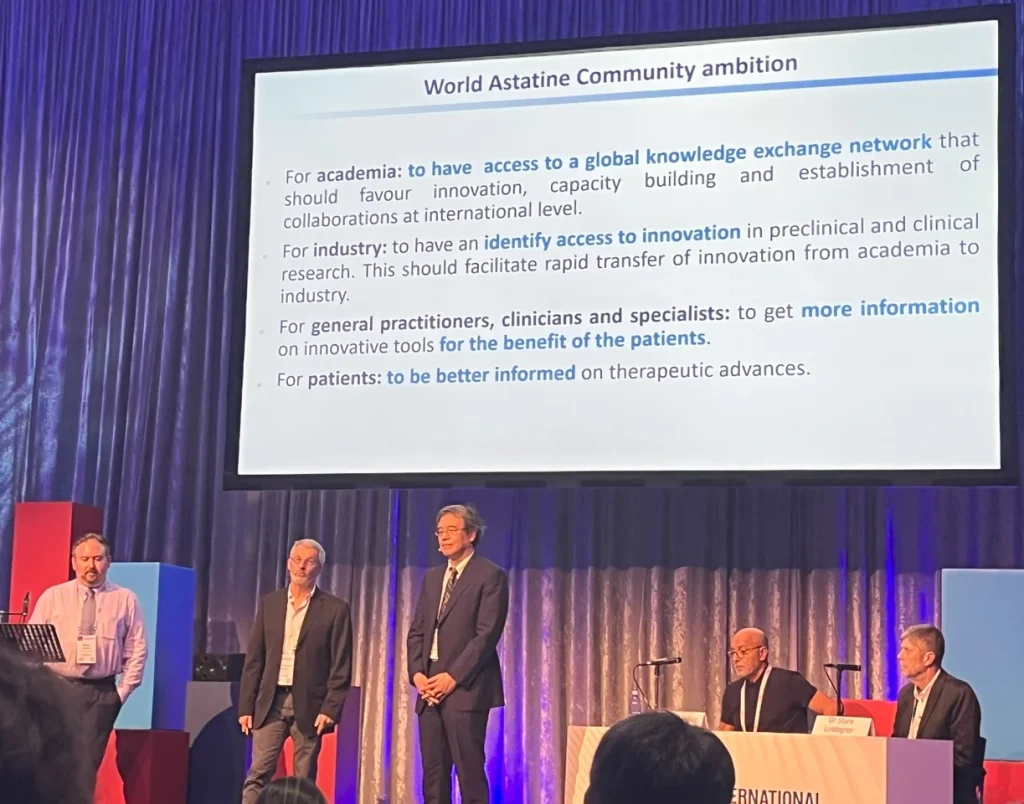
At the TAT12 conference in April 2023, Alpha Fusion board member Takashi Nakano shared the stage with representatives from the U.S. Department of Energy and Europe’s COST-NOAR network to announce the formation of WAC. Since then, Alpha Fusion has led discussions on astatine R&D at key events including the COST-NOAR meeting in May 2023 and the 7th Theranostics World Congress in March 2024.
Sumitomo’s Commitment to Astatine Supply
At the briefing, Kazuya Taki of Sumitomo’s Industrial Machinery Division presented the company’s plan to ensure a reliable supply of astatine-211, under the slogan: “Never let drug development be delayed by astatine shortage.” He announced plans to install the world’s most productive astatine-211 cyclotron at the TAT Cyclotron Building by 2026 and emphasized efforts to promote global, not just domestic, availability.
Clinical Trials and Future Outlook
Clinical trials of [At-211]NaAt for refractory differentiated thyroid cancer began in November 2021 at Osaka University Hospital.*2 In June 2024, trials of [At-211]PSMA-5 for refractory prostate cancer will begin.*3 Alpha Fusion, as the startup driving these clinical-stage programs, aims to obtain marketing approval through partnerships with major pharmaceutical companies and academic institutions.
In parallel, Alpha Fusion continues to develop a pipeline of novel astatine-based radiopharmaceuticals that address high unmet medical needs across multiple cancer types.
*1 Source: Fusion Pharmaceuticals presentation at the IAEA International Symposium (2023)
*2 https://prtimes.jp/main/html/rd/p/000000001.000091191.html
*3 https://prtimes.jp/main/html/rd/p/000000009.000091191.html
(Read More in Japanese)